Protect Your Health Because It’s Your Superpower
As women in positions of responsibility, we’re exceptional at delivering, supporting, juggling, and holding everything together. We push through long days, solve problems on the fly, and keep showing up — often without noticing what our bodies are quietly carrying.
We take our health for granted… until the moment we realise we don’t have it anymore.
Last summer was supposed to be one of my most active, adventurous seasons. I had plans: hill walking, waterskiing, exploring beautiful places, and finally giving myself the gift of more time in nature.
But four days before the end of the school term, I headed out for a quick evening waterski — the perfect reset after a busy week. The lake was calm, golden, gorgeous… until a rogue wake from another boat caught me at the wrong angle. I spun out, hit the water hard, and knew something wasn’t right.
I’d broken the bottom of my tibia.
I needed surgery.
Two pins.
And absolutely no adventures for the entire summer.
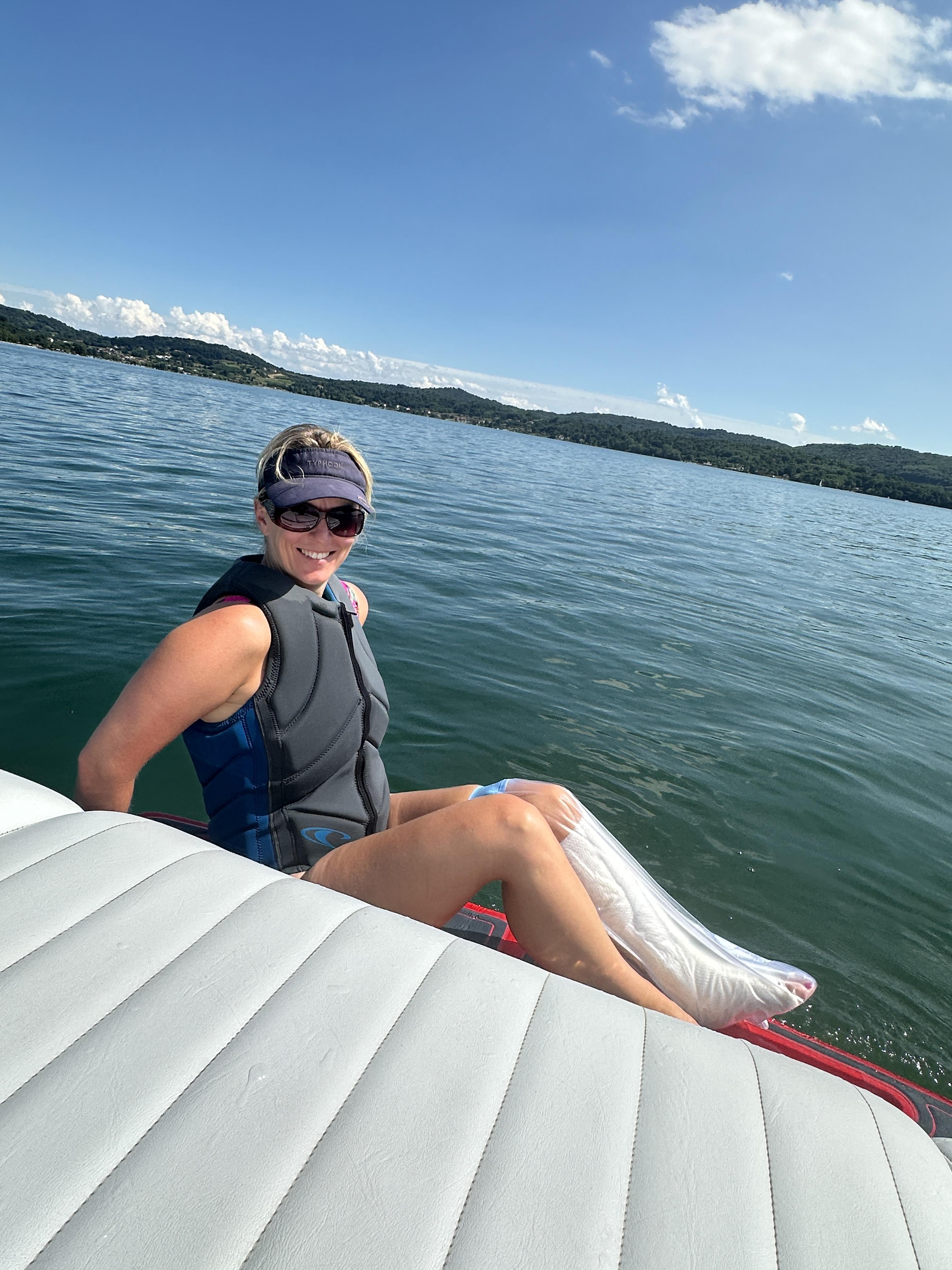
(Though — thanks to a giant plastic sock recommended by a friend — I did manage one glamorous, one-legged float in the lake.)
And in the grand scheme of things, my injury was fairly minor.
Many people face far worse.
But it was still a powerful reminder of how quickly everything can change.
So I committed to the rehab.
I did my physio.
I trained hard.
And I was genuinely delighted to get back behind the boat less than four months later — tentatively, carefully, but joyfully.
And even more delighted to be back on the slopes the following month.
Someone asked me this week: “What brings you joy?”
And I realised the answer wasn’t just the activity — it was the gratitude behind it.
My ankle is still not perfect.
But I can do the things that bring me joy with my family — and for that, I am profoundly grateful.
Grateful enough to look after myself.
Grateful enough to protect the body that allows me to live the life I love.
The Science We Can’t Keep Ignoring
1. Estrogen declines — and with it, our natural protection.
As estrogen drops in our 40s and 50s, we lose the hormonal support that once protected our bones, muscles, metabolism, and cardiovascular system. This isn’t a small shift — it’s a fundamental biological transition.
2. Muscular degeneration accelerates after 50.
Both men and women lose muscle with age — but for women this accelerates significantly once estrogen lowers. Less muscle means reduced strength, lower metabolic rate, poorer balance, and increased injury risk.
3. Bone health deteriorates rapidly post-menopause.
Estrogen is essential for maintaining bone density. When levels fall, bone turnover speeds up — making fractures more likely (as I learned firsthand).
4. Cardiovascular disease is the leading cause of death among women.
This risk increases significantly through the menopause transition. As estrogen’s protective effect declines, blood vessels stiffen, cholesterol patterns shift, inflammation rises, and overall cardiovascular risk climbs sharply.
Yet many women still assume heart disease is “a male issue.”
It isn’t.
Your Health Is Not a Luxury — It’s Your Leadership Foundation
When your muscle mass drops, when your bones weaken, when your cardiovascular health shifts — you feel it.
In your energy.
Your stamina.
Your clarity.
Your confidence.
Your resilience.
Your ability to lead with presence rather than pressure.
And here’s something else we don’t talk about enough:
You want to be healthy for now… but you also want to be able to enjoy and make the most of your life well into your retirement.
You want to hike the hills, ski the mountains, travel, play, explore, lift your grandchildren, swim in lakes, and live your life fully — not sit on the sidelines wishing you could.
Everything you do for your health today is a long-term investment in the life you’ll be able to live tomorrow.
This isn’t about vanity or perfection.
This is about longevity, vitality, independence, and protecting the only body you will ever have.
So here’s your reminder:
Protect your health with the same commitment you protect your responsibilities.
Lift weights.
Build muscle.
Support your bones.
Look after your heart.
Move often.
Fuel well.
Rest before your body forces a pause.
Because when you take care of your physical foundation, everything else — your wellbeing, your leadership, your clarity, your joy — becomes so much easier to access.
If you’re thinking “I’ve been neglecting myself,” you’re not alone.
Most women only realise it after something goes wrong.
But you don’t need a wake-up call like mine.
You can choose differently today.
One small habit.
One simple act of care.
One steady, intentional step at a time.

References Used:
Adach, W., et al. (2022). Menopause and women’s cardiovascular health – is it really an obvious relationship?Archives of Medical Science, 19(2). https://doi.org/10.5114/aoms/157308
Buckinx, F. & Aubertin-Leheudre, M. (2022). Sarcopenia in menopausal women: Current perspectives.International Journal of Women’s Health, 14, 805–819. https://doi.org/10.2147/IJWH.S340537
El Khoudary, S.R., et al. (2020). Menopause transition and cardiovascular disease risk: Implications for timing of early prevention. A scientific statement from the American Heart Association.Circulation, 142(25). https://doi.org/10.1161/CIR.0000000000000912
Geraci, A., et al. (2021). Sarcopenia and menopause: The role of estradiol.Frontiers in Endocrinology, 12, Article 682012. https://doi.org/10.3389/fendo.2021.682012
International Osteoporosis Foundation (2013) Osteoporosis in the European Union: Medical management, epidemiology and economic burden. World Osteoporosis Day Thematic Report 2013. Available at: https://share.osteoporosis.foundation/WOD/2013/thematic-report/WOD13-Report.pdf
Johnson, A. (2025). The Menopause Coach Manual. 1st edn.
Piskorz, A. & Brzostek, T. (2015). Comparison of SCORE-predicted risk of death due to cardiovascular events in women before and after menopause.Menopausal Review, 3, 168–172. https://doi.org/10.5114/pm.2015.54340
Vervoort, D., et al. (2024). Addressing the global burden of cardiovascular disease in women.Journal of the American College of Cardiology, 83(25), 2690–2707. https://doi.org/10.1016/j.jacc.2024.04.028
Yousefzai, S., et al. (2025). Cardiovascular health during menopause transition: The role of traditional and nontraditional risk factors.Methodist DeBakey Cardiovascular Journal, 21(4), 121–128. https://doi.org/10.14797/mdcvj.1619