
Why Nature Restores Leadership, Energy & Wellbeing
Why Nature Restores Our Leadership, Energy & Wellbeing
We talk a lot about strategy, productivity, boundaries and resilience in leadership.
But one of the most powerful wellbeing tools we have, especially in midlife, is often the simplest one.
It’s sitting right outside our front door.
Nature regulates us in ways our modern lives simply don’t. And if you’re a woman carrying responsibility, decisions, emotional labour, and the hormonal shifts of your 40s and 50s, that regulation isn’t a luxury - it’s essential.
When I’m feeling anxious, stuck, or quietly sad, I take myself outside. I don’t overthink it. I just go. Within a few minutes of walking in nature, I can feel my system begin to settle. My breathing softens. My thoughts slow. I start to come back to myself.
I try to get outside every day, even if it’s only briefly. And when I do, I make a point of noticing something beautiful - the sky, the outline of the mountains, a flower pushing stubbornly through the cold.
If I haven’t managed to get out until after dark, I’ll pause and look up at the night sky. There’s something about that perspective that always brings me home.
This past week has been full of those moments.
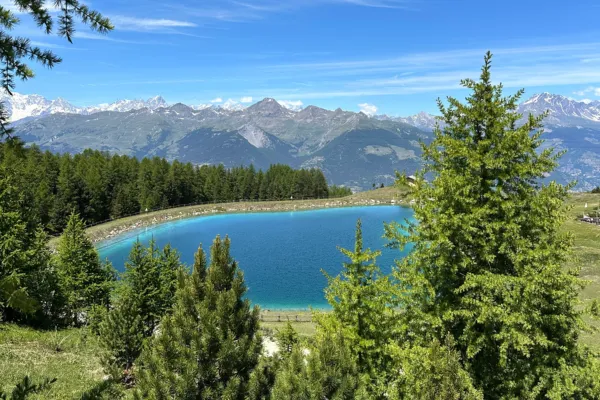
Skiing beneath the quiet majesty of the Matterhorn. Walking along the shores of Lago di Viverone, the water changing colour with the light. And one evening, wrapping both myself and my mum in far too many layers so we could sit outside in deck chairs and watch the Geminid meteor shower.
I must have counted thirty streaks of light which I got very excited by, Mum kept waiting for something more dramatic, we had such a laugh.
The images I share in my work come from this same place - the everyday wonder of the world around me. I’ve deliberately chosen to live somewhere that keeps me close to nature, because I know how deeply it lifts me, especially when life feels full or demanding.
Not everyone has easy access to mountains or lakes, I understand that. But there are always small ways to reconnect - a patch of sky, a tree-lined street, a park, a moment of stillness outdoors. And when possible, a longer exposure to nature in the countryside, by the sea, or in a natural park at the weekend can do wonders for wellbeing. If you can combine it with exercise a walk, cycle, run – then all the better.
And those moments matter more than we often realise.
They don’t just soothe us.
They help us remember who we are.
1. Nature helps your nervous system stand down
When life feels relentless, your body often stays in a low-level state of alert, even when you’re not consciously stressed.
Stepping outside, even briefly, can interrupt that pattern. Stress hormones begin to fall, breathing steadies, and the nervous system shifts out of “holding it all together” mode and into something calmer. Research consistently shows that natural environments help the body recover from stress more quickly than built or indoor spaces (Ulrich et al., 1991).
That’s why clarity so often arrives on a walk, not at a desk.
2. Nature restores the mental energy leadership uses up
Leadership quietly drains very specific parts of the brain: decision-making, emotional regulation, perspective, creativity.
Nature gives those systems a break.
Studies show that time outdoors, even in small doses, restores attention and working memory, and reduces the mental fatigue that comes from constant responsibility (Berman et al., 2008).
The more you’re holding, the more essential this kind of restoration becomes.
3. In midlife, nature supports balance — not just mood
Hormonal shifts in our 40s and 50s can make stress feel sharper, sleep more fragile, and emotions closer to the surface.
Spending time outdoors, particularly in natural light, helps realign circadian rhythms - the internal clock that governs sleep, energy, and mood. Research shows that modern indoor lifestyles easily disrupt this rhythm, while exposure to natural light–dark cycles supports more stable physiological regulation (Wright et al., 2013).
This isn’t about “getting away from it all”.
It’s about working with your biology, not against it.
4. Walking outside changes how the mind loops
A slow walk in nature does more than move the body.
It interrupts rumination - the repetitive, sticky thinking that fuels anxiety and self-doubt. Research shows that walking in natural environments reduces rumination far more effectively than walking in urban settings (Bratman et al., 2015).
This is why so many women describe feeling more grounded, more like themselves, once walking becomes a regular rhythm.
5. Nature reminds us that life is bigger than the moment we’re in
Wide horizons, trees, water, anything larger than us, has a quiet psychological effect.
It softens urgency. It creates space around our thoughts. It helps the nervous system regain perspective. Studies link exposure to these environments with reduced perceived stress and improved emotional balance (White et al., 2019).
Problems don’t disappear.
They just stop feeling like the whole world.
Final thought
Nature isn’t a luxury - It’s regulation - It’s recovery - It’s leadership maintenance.
And for women in midlife, navigating responsibility, identity shifts, and hormonal change, it’s one of the most powerful wellbeing practices available.
Your body knows what to do when you step outside.
Sometimes the wisest thing we can do is follow it.

References Used:
Berman, M. G., Jonides, J. and Kaplan, S. (2008) ‘The cognitive benefits of interacting with nature’, Psychological Science, 19(12), pp. 1207–1212. https://doi.org/10.1111/j.1467-9280.2008.02225.x
Bratman, G. N., Hamilton, J. P. and Daily, G. C. (2015) ‘The impacts of nature experience on human cognitive function and mental health’, Proceedings of the National Academy of Sciences, 112(28), pp. 8567–8572. https://doi.org/10.1073/pnas.1510459112
Twohig-Bennett, C. and Jones, A. (2018) ‘The health benefits of the great outdoors: A systematic review and meta-analysis of greenspace exposure and health outcomes’, Environmental Research, 166, pp. 628–637. https://doi.org/10.1016/j.envres.2018.06.030
Ulrich, R. S., Simons, R. F., Losito, B. D., Fiorito, E., Miles, M. A. and Zelson, M. (1991) ‘Stress recovery during exposure to natural and urban environments’, Journal of Environmental Psychology, 11(3), pp. 201–230. https://doi.org/10.1016/S0272-4944(05)80184-7
White, M. P., Alcock, I., Grellier, J., Wheeler, B. W. and Fleming, L. E. (2019) ‘Spending at least 120 minutes a week in nature is associated with good health and wellbeing’, Scientific Reports, 9, 7730. https://doi.org/10.1038/s41598-019-44097-3
Wright, K. P., McHill, A. W., Birks, B. R., Griffin, B. R., Rusterholz, T. and Chinoy, E. D. (2013) ‘Entrainment of the human circadian clock to the natural light–dark cycle’, Current Biology, 23(16), pp. 1554–1558. https://doi.org/10.1016/j.cub.2013.06.039