
Five Protective Patterns Women in Leadership Carry

You Are Not the Only One
Something comes up in almost every conversation I have with women in leadership. It takes different forms depending on the person, the role, the context. But underneath it, the feeling is usually the same.
I assumed I was the only one who felt this way.
We look around and imagine that everyone else is more confident, more capable, more balanced. We assume we are somehow the outlier. The one who is holding it together on the outside while quietly questioning herself on the inside.
The truth is, we only ever see what people choose to show.
What are protective patterns?
Over 25 years in senior leadership, and now through my coaching work with women across education, healthcare and business, I have come to understand that what many of us carry are not character flaws. They are protective patterns. Intelligent strategies that we developed, often very early in life, to help us belong, succeed, stay safe and be valued.
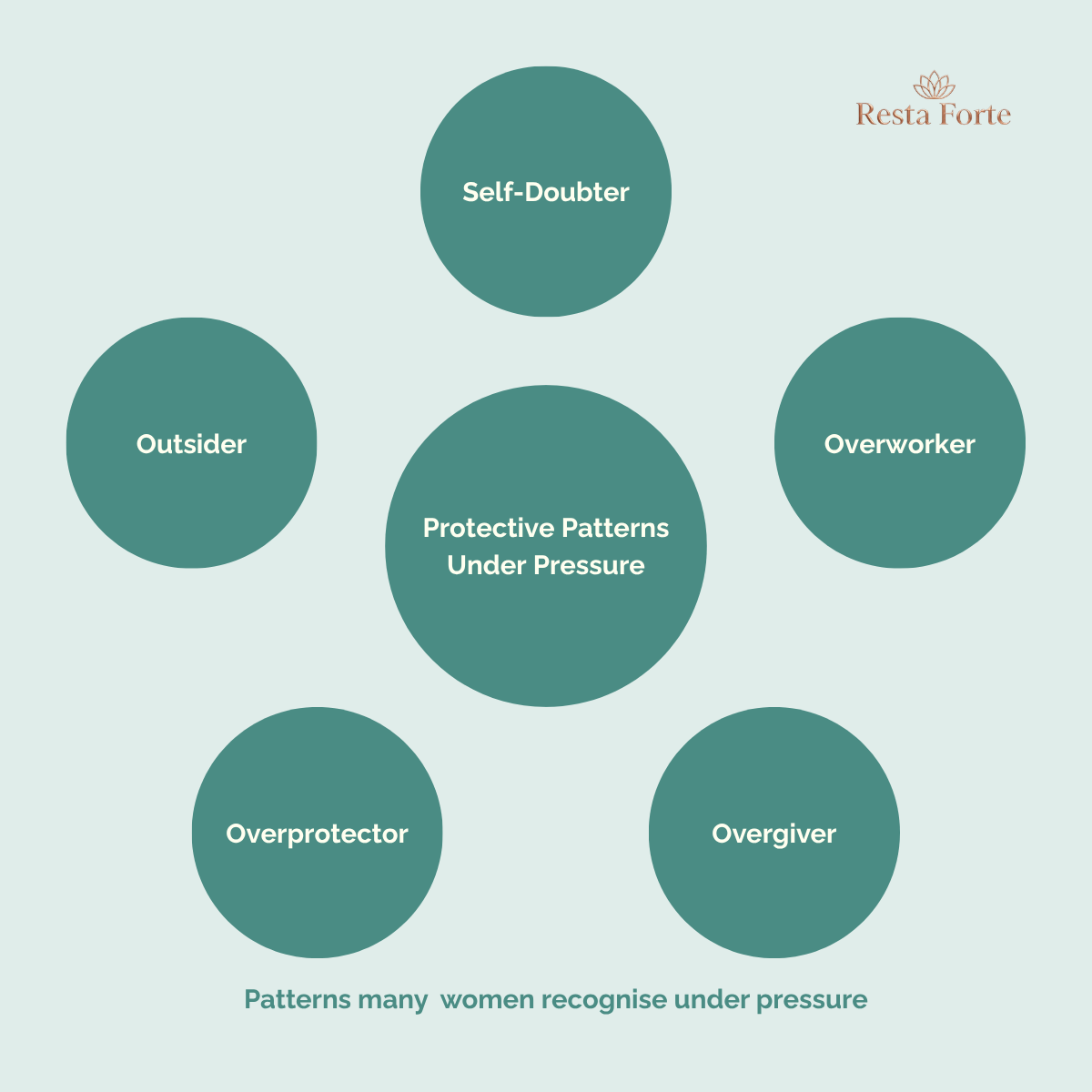
I call them the Overworker, the Overgiver, the Overprotector, the Outsider and the Self Doubter.
The Overworker cannot switch off. She proves her worth through productivity and finds it genuinely difficult to stop, even when her body and mind are asking her to.
The Overgiver puts everyone else first, automatically. She struggles to say no, takes on too much, and often runs on empty because her own needs consistently come last.
The Overprotector holds everything tightly. She finds it hard to delegate or let go, and feels responsible for managing every detail and every outcome.
The Outsider feels on the edge, even in rooms where she belongs. She can appear confident while quietly wondering whether she really fits.
The Self Doubter questions herself even when she already knows the answer. She replays conversations, second-guesses decisions, and carries a persistent worry that she is not quite enough.
Most women recognise themselves in more than one. That is entirely normal.
These patterns are not the problem
In many ways, these patterns have served us well. The women I work with have achieved a great deal in their lives and careers. These patterns have often been part of what made that possible. The difficulty comes when they start running automatically, without our awareness. That is when they shift from being useful to quietly getting in the way.
A few weeks ago I was speaking with a very successful school leader. She has led multiple schools and has been publicly recognised for her contribution to education. She told me she has carried self doubt throughout her entire career. Her staff, her parents and school community would never guess.
If you care deeply about your work and about the impact you have on others, these patterns will appear at times. They are not a sign that you are failing. They are a sign that you care.
When they get louder
These patterns tend to become more insistent when life is demanding. A difficult period at work. A change such as moving house or changing jobs. A disruption in a relationship. Hormonal shifts during pregnancy or midlife. Whenever things feel uncertain, our system reaches for what feels familiar and protective.
For me, the Overworker is usually the first to arrive. I feel the familiar pull to power on and prove my worth through doing more. The Outsider can follow. I become quieter and more insular, and it feels easier to stay in my own company than to be visible, whether that is in person or online.
Over time I have developed ways of noticing these patterns earlier and gently interrupting them before they run the show. That does not mean they disappear. They still try to slip in quietly. I catch them sooner now, and that changes the outcome.
The work is not elimination — it is awareness
Most of us have one or two patterns that show up most often, though all of them can appear at different times. The aim is not to get rid of them. It is to recognise when they have shifted from being helpful to taking over. To create enough space between the trigger and the response that you can choose how to act, rather than reacting on autopilot.
That awareness is always the starting point.
A reflection
Take a few quiet minutes and see what comes up.
Which of these patterns do you recognise most in yourself?
When does it tend to show up? What is usually happening in your life at that point?
And when you notice it arriving, what might it actually be trying to protect you from?
No fixing. No judgement. Just noticing.
Jo Urquhart is the founder of Resta Forte, a coaching and leadership development practice for women in senior roles. If something here has resonated and you would like to explore this further, you are welcome to book a free 30-minute introductory call.